
.svg)




The Six Axes of Luxury Hotel Photography: How to Tell a Property's Argument from Generic Luxury Aesthetics

Why Do Most Luxury Hotel Photographs Look the Same?
Quick answer: Open the Instagram grid of any five-star property opened in the last decade and then open a second. The light temperature is identical. The model is positioned at the same 45-degree diagonal from the window. The palette runs cream to deep walnut, with one strategic gold accent. If you swapped the captions, no one would notice for at least three scrolls.
This is not a coincidence. After 2008, when hotel investment tightened and risk appetite narrowed, the industry converged on a single visual language because it tested well. Soft warm light. Aspirational figures in draped fabrics. Compositions that signal luxury through symmetry and depth. It works at the level of the category. It communicates nothing at the level of the property. The Hotel Imperial Vienna, the Hotel de Crillon, the Aman Tokyo, and a new Four Seasons in Riyadh are all different buildings in different centuries with different architectural arguments. The photography has made them look like variations on the same brief.
The six axes below are where that problem gets solved.
Architecture as the Frame's Argument
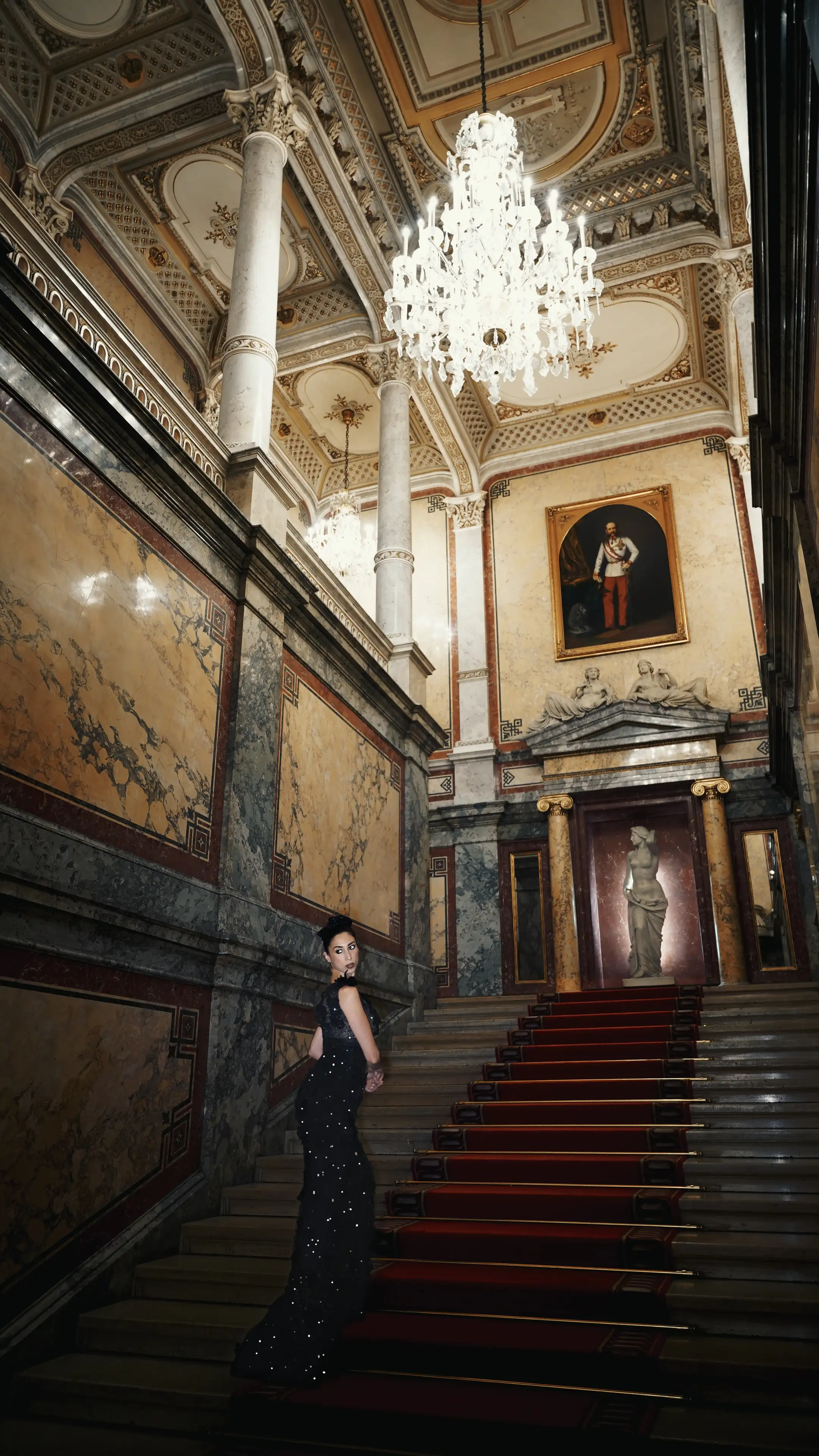
The Grand Staircase of the Hotel Imperial was built between 1863 and 1865 by architect Arnold Zenetti of Munich for Duke Philipp of Württemberg. It is a processional structure in Kaiserstein limestone, a hard yellow algae limestone quarried at Kaisersteinbruch, with Carrara marble columns in the great hall and Giallo di Siena marble in the ballroom. It was not designed as a hotel amenity. It was designed as a ducal entrance sequence, a spatial gradient from public to private that expressed the rank of the person ascending it. When the financier Horace Ritter Von Landau purchased the Palais in 1872 and converted it for the 1873 Vienna World's Fair, the staircase came with the building intact. It has not been substantially altered since.
Photographed decoratively, it is a beautiful staircase in a beautiful hotel. Every photographer who has ever pointed a lens at it has gotten that image. Photographed argumentatively, it becomes something specific: a 161 years old processional axis that is still doing exactly what it was designed to do, in a building that was not designed to be a hotel, whose spatial logic therefore carries the logic of a different and more demanding era.
These are not the same photograph. The first requires a good eye. The second requires understanding what you are looking at before you open the lens.
Light as Information, Not Atmosphere
The most expensive mistake in hotel photography is shooting the location at the wrong time and grading the light in post to compensate. It produces images that look warm. It does not produce images that look like that specific building at the moment when the building is most fully itself.
The Grand Staircase at the Hotel Imperial has a 35-minute window, between 7:20 and 7:55 AM during the spring and autumn equinoxes, when direct sunlight enters at the exact angle the architecture was designed to receive. Outside that window the staircase is lit by diffuse ambient. Inside it, the light is completing the design. The fifth-floor duplex suites carry a 40-minute window between 9:00 and 9:40 AM in late spring when southern light produces what art historians consistently describe as Caravaggesque quality: a single directional source, a sharp shadow boundary, and an exposure gradient across the shadow edge that no post-production grade can accurately replicate. The fifth-floor corridor has a 12-minute intersection at 5:50 AM in midsummer when dawn light allows the suite doors' amber bars to cross the wool carpet before the automatic ceiling fixtures activate.
Each of these windows is non-repeatable within the same morning. Miss the corridor at 6:02 AM and it is gone. Arrive at the staircase at 8:00 AM and you are shooting a different building.
The fifth-floor rooms on the Ringstraße side have an evening the morning sessions never see.
In summer, Vienna's sun sets close to 21:00, and in the last hour before it goes, the light swings northwest and hits the hotel's facade at the kind of angle that makes stone look like stone again. The carved ornament above the portal, the pilasters, the heraldic figures that have been sitting there since 1866, all of it comes forward. Shadows appear where at noon there were none. The building stops looking like a photograph of itself and starts looking like a building.
From a fifth-floor balcony around 19:30, the Ringstraße is doing something it does once a day and only in the right season. The Musikverein across the boulevard is lit from the same source. The linden trees along the avenue go the colour that linden trees go in that light. The road surface, which is just a road at any other hour, picks up enough warmth to look like it belongs to the same century as everything around it.
Photographers call this golden hour, which is accurate but undersells it. What is actually happening is that a facade built in the 1860s to be read in low evening light by people arriving by carriage is finally being read in low evening light. The geometry the architects put into that stone was not decorative. It was designed for exactly this angle. A frame from that balcony at 19:45 in June is not a sunset shot. It is the building saying what it was always going to say, at the hour it was always going to say it.
Time as a Production Asset
Most productions are organised around the team's logistical convenience. This is understandable and produces average results.
The Hotel Imperial operates on several temporal layers simultaneously: the light windows, guest movement patterns (the Café Imperial fills by 7:30 AM, the lobby clears between 10 and 11 AM), and the seasonal solar calendar that determines which windows are available on which dates. A production that treats the building seriously schedules itself inside these layers rather than around them. The call time is 5:30 AM and he staircase window opens at 7:20 AM. These are not suggestions. They are the building's operating hours for the kind of photography under discussion.
Richard Wagner took seven rooms at the Imperial when he visited Vienna. Brahms was a regular at the Café Imperial. Charlie Chaplin arrived in 1931 to 4,000 people outside the door and described his room as the finest he had encountered. John F. Kennedy and Nikita Khrushchev both slept here during the 1961 Vienna Summit. The building has been photographed thousands of times. The photographs that carry its specific argument, rather than the generic luxury hotel argument, are the ones made inside its temporal logic rather than imposed upon it.
Figure as Compositional Decision
The Grand Staircase's second-floor landing has a specific compositional structure: dark vertical elements against warm horizontal stone, with directional upper light. A figure placed there is either composited into that structure or placed in front of it. The difference is visible immediately and cannot be corrected in post.
A structured wool coat with vertical seams aligned to the wrought-iron balustrade is not a wardrobe choice made in a studio. It is a decision made by someone who has stood on that landing and understood what the geometry is doing. Wedding photography at the Imperial works at the highest editorial level when the bridal figure is placed inside the architectural rhythm rather than positioned against it as a backdrop. This is the difference between a wedding photograph taken at the Imperial and a wedding photograph that is of the Imperial.
Register as a Conscious Choice
Register is the formal level of the image's address: documentary, architectural, lifestyle, bridal, fashion editorial, aristocratic. Each has its own conventions. Each is appropriate to a different kind of property. The failure mode is choosing the wrong register for the building and then executing it with technical competence.
The Hotel Imperial was built as a ducal palace in the Italian Neo-Renaissance style, inaugurated as a hotel by Emperor Franz Joseph I on April 28, 1873, and has since hosted every significant head of state and cultural figure who passed through Vienna for a century and a half. Its four portal figures by sculptor Franz Melnitzky represent wisdom, honour, justice, and strength. The register the building occupies is aristocratic, formal but not performative, period-respectful but not nostalgic. A fashion editorial register treats it as a backdrop. A documentary register underuses it. A lifestyle register makes it look like a boutique hotel. None of these are wrong registers in general. All of them are wrong for this building.
The register decision is made before any equipment is unpacked. It determines wardrobe, model casting, lighting approach, and post-production grading. A production team that arrives at the Imperial without having made this decision will default to whatever register they used last week. The building will look like their other work. It will not look like itself.
The Sixth Axis
The sixth axis is whether the photographer has been inside the building or merely inside the booking. The five axes above are outcomes of a specific kind of preparation: reading the architectural history, studying the solar geometry for the date and season, visiting the light windows before the production day, standing on the second-floor landing and understanding what the proportions are doing before deciding where the figure goes.
This preparation is not standard. Most productions arrive with equipment and a schedule. The equipment is excellent. The schedule is efficient. The images are technically correct. And they could have been produced at any of seventy other luxury hotels by any of forty other production teams, because the preparation that would have made them specific to this address was not done.
The Six Axes of Luxury Hotel Photography — Calibration Reference
Palette as the Building's Memory
The sixth axis is the colour palette of the finished photograph. Most luxury hotel photography is graded toward a small set of palettes — warm cream, deep gold, soft champagne. These palettes work because they read as luxury. The sixth axis asks whether the palette reads as the specific building or as the luxury category.
Suite 101 at the Imperial Hotel Vienna has a palette of warm stone, oxidised gold, and aged ivory. Suite 108 has a palette of ivory, celadon, and pale rose. These are different rooms with different palettes within the same property. Photography that grades both rooms to the same warm cream palette has erased the distinction. Photography that preserves each room's specific palette has captured what the property actually is.
The sixth axis is a post-production decision. The grader has to know the palette of each location and grade specifically to it, resisting the gravitational pull toward the universal luxury palette. This requires the colour science to be set up location by location rather than batch-processed across the entire shoot. It is more expensive. It produces content that argues.
How are made Wedding Photography at a Palace Hotel?
Wedding photography is the most common use case for which clients book a heritage property like the Imperial Vienna. The application of the six axes to wedding photography is specific and worth describing.
This is what wedding photography at a heritage palace hotel looks like when produced at the level the property requires. Wedding photography Imperial Hotel Vienna, principessa editorial, and bridal shoot Vienna palace hotel are the search terms clients use to find this register. The work itself is the six axes applied to one specific use case.
How Does Cover Page Calibrate Across All Six Axes?
Cover Page's content creation service structures every production around the six axes from pre-production onward. The architecture is read before the team arrives. The light windows are scheduled. The temporal layers are mapped against the schedule. The figure decisions are made in wardrobe consultation. The register is selected and locked. The palette is graded location by location.
This is not a luxury approach. It is the only approach that produces content carrying the property's specific argument. A team that operates along all six axes arrives at a property prepared to make it visible. A team that operates along fewer axes arrives at a property prepared to make it interchangeable with the rest of the category.
The price difference between the two approaches is operational, not creative. Reading the architecture takes hours of pre-production. Scheduling the light windows takes coordination with the property. Grading location by location takes more colourist time than batch processing. Cover Page Agency prices the UNO package at AED 2,500 specifically to make the six-axis approach available to clients who would otherwise default to the four-axis approach because the price difference seemed unjustified. The difference is not the price. It is the content.
Six Axes of Luxury Hotel Photography — 10 Things That Separate Property from Category
- 01 Architecture as argument, not decoration. A beautiful staircase is wallpaper. The Grand Staircase photographed as the processional axis Franz Joseph I commissioned in 1873 — with its 35-minute morning light window — is content.
- 02 Light as information, not atmosphere. The 35-minute Grand Staircase window. The 40-minute duplex staircase Caravaggio window. The 12-minute corridor amber bars. Each is a specific photograph that contains information about the building — not a warm glow that reads as luxury.
- 03 Time as a production asset. The call time is 5:30am because the corridor opens at 5:50am. The building has fixed temporal layers. A production that respects them schedules itself inside them — not around the team's convenience.
- 04 Figure as compositional decision. A model placed in front of the Grand Staircase is a portrait. A model with a structured wool coat whose vertical seams align to the balustrade ironwork — that body extends the building's rhythm rather than interrupting it.
- 05 Register chosen before the lens opens. The Imperial Vienna requires the aristocratic register — formal but not performative, period-respectful but not nostalgic. A fashion editorial register overdresses it. A documentary register underuses it. Register is selected in pre-production, not discovered on set.
- 06 Palette as the building's memory. Suite 501 is warm stone and oxidised gold. Suite 508 is ivory and celadon. Grading both to the same generic luxury cream erases the distinction. Location-by-location colour science preserves it.
- 07 Wedding photography Imperial Hotel Vienna — principessa editorial. The bridal sequence across three locations: Grand Staircase at 7:20am, duplex staircase at 9:00am, French balcony at noon. Three lights, three registers, one morning. The principessa register — not dreamy soft-focus — matches the property.
- 08 The axis most teams skip: palette. Post-production grading happens after the team has left the property. The mood board defaults to luxury cream and gold. The fix is location-by-location colour notes taken on the day with a reference card — operationally tedious, visually irreplaceable.
- 09 Four-axis vs six-axis production. Most luxury hotel photography calibrates architecture, light, figure and palette. The two omitted axes — time and register — are the difference between content that argues for a property and content that argues for the luxury category in general.
- 10 GCC luxury content that distinguishes property from category. Dubai's luxury photography market is saturated at the four-axis level — beautiful, well-lit, technically excellent, palette-generic. Six-axis production is how a specific property becomes visible rather than interchangeable. Cover Page UNO from AED 2,500.
What Is the One Axis Most Teams Skip?
Axis six. Palette. Post-production grading is where the location-specific approach most often collapses into the generic luxury approach, because grading happens after the team has left the property and the gravitational pull of the universal palette is hardest to resist. The grader is working from footage and stills without the property in front of them. The reference is the mood board. The mood board defaults to luxury cream and gold.
The fix is location-by-location colour notes taken on the day, photographed against the location's actual surfaces with a reference card, and applied as constraints in the grading session. This is operationally tedious. It produces palettes that read as the specific building rather than the luxury idea. Skipping this step is the most common reason a heritage property production looks like a generic luxury production despite being shot at a non-generic location.
Why Does This Matter for the GCC Luxury Market?
Cover Page operates primarily in the Dubai, Milan, and Lyon luxury markets. The GCC luxury category in particular is saturated with photography at the four-axis level — architecturally beautiful, well-lit, technically excellent, palette-generic. A client commissioning content production for a GCC luxury launch needs imagery that distinguishes the property from the category. The six-axis approach is how that distinction is produced.
A heritage property production at the Imperial Vienna becomes, for a GCC client, the reference point that calibrates expectation. The footage produced at the Imperial Vienna shows what a six-axis approach produces. Subsequent productions at Dubai properties, different architecture, different light, different palette, can then be calibrated to the same six-axis standard, producing content that argues for each specific Dubai property rather than for the generic luxury category.
For enquiries about heritage property productions, wedding photography at palace hotels, or six-axis productions in the GCC: WhatsApp +971 52 401 8887 or info@coverpage.ae. See also models for editorial casting and talents for production team coordination.
FAQ
What are the six axes of luxury hotel photography?
The six axes are architecture, light, time, figure, register, and palette. Together they form the calibration framework that determines whether a luxury hotel photograph carries the property's specific argument or generic luxury aesthetics. Most luxury hotel productions calibrate four of the six. The two most commonly skipped are register (chosen deliberately rather than defaulting to soft luxury) and palette (graded location-by-location rather than batch-processed to a universal luxury cream).
Why do most luxury hotel photographs look the same?
Most luxury hotel photography operates on the four-axis approach — architecture, light, figure, palette — graded toward a universal luxury aesthetic. The category's visual language has converged across properties to the point where a guest cannot tell which hotel a photograph depicts. The six-axis approach adds time as a production asset and register as a conscious choice, producing content that argues for the specific property rather than the luxury category.
Does architecture serves as decoration?
Axis one is the difference between architecture as decoration (beautiful background) and architecture as argument (the period reasoning the photographer has read in advance). The Grand Staircase photographed decoratively is a beautiful staircase. Photographed argumentatively, it is the processional axis Franz Joseph I commissioned in 1873, with the directional light window the architects intended. Same staircase, two different photographs. The first axis is the foundation everything else builds on.
What is light vs atmosphere?
Light is information rather than atmosphere. The Grand Staircase has 35 minutes between 7:20 and 7:55am when direct light enters the glazed lantern at the angle the architecture was designed to receive. The duplex staircase has 40 minutes from 9:00am when the south window produces Caravaggio-quality directional light. The corridor has 12 minutes from 5:50am. Each is a specific photograph that contains information about the building.
What are theframeworks that apply to wedding photography at a palace hotel?
Wedding photography at the Imperial Vienna applies all six axes specifically. The Grand Staircase at 7:20am for the descending bridal sequence. The duplex staircase at 9:00am for private Caravaggio frames. The French balcony at noon for open Ringstrasse light. Structured bodices rhyme balustrade verticals. The principessa register replaces dreamy soft-focus. The palette is graded location-by-location. This is wedding photography Imperial Hotel Vienna at the level the property requires.
What is a compositional decision?
Axis four places the figure inside the location's compositional logic rather than in front of it. At the Grand Staircase second-floor landing, a structured wool coat with vertical seams aligned to the balustrade ironwork extends the building's vertical rhythm. The body becomes part of the architectural argument rather than an addition to it. This is also what distinguishes principessa editorial and bridal shoot Vienna palace hotel work from generic palace-hotel weddings.
What is axis five: register as a conscious choice?
Documentary, lifestyle, fashion editorial, bridal, aristocratic, and so on. Axis five asks whether the register matches the property. The Imperial Vienna requires the aristocratic register: formal but not performative, period-respectful but not nostalgic, structured but not stiff. A fashion editorial register overdresses the building. A documentary register underuses it. Register selection happens before opening a lens.
How does people remember the colour palette of an hotel?
Axis six is colour palette in post-production. Most luxury hotel grading defaults to warm cream and gold. The six-axis approach grades each location to its specific palette. Suite 501 is warm stone and oxidised gold. Suite 508 is ivory and celadon. These are different palettes within the same property. Grading both to the same generic luxury cream erases the distinction. Location-by-location colour science preserves it.
Which axis do most production teams skip?
Post-production grading is where the location-specific approach most often collapses into the generic luxury approach, because grading happens after the team has left the property. The grader is working from footage and stills with no access to the actual surfaces. The mood board defaults to luxury cream. The fix is location-by-location colour notes taken on the day with reference cards, applied as constraints in the grading session.
How does Cover Page apply the six-axis framework to every production?
Cover Page operates the six-axis framework as the default approach to every content production, with packages starting at AED 2,500 for UNO. The framework is built into pre-production: the architecture is read, the light windows mapped, the temporal layers respected, the wardrobe selected against geometry, the register chosen and locked, the palette graded location-by-location. Contact via WhatsApp at +971 52 401 8887.
About the Authors
.webp)
Lukas Götze
Marketing Director, Cover Page Agency
12 years and over 1,000 successful activations across Dubai, Milan and Lyon since 2015. Specialising in turning events into brand moments through professional content and verified results.

Enzo Marcelle
Web Designer & Copywriter, Cover Page Agency
Specialising in SEO-optimised websites, AI-driven content strategies and digital experiences for luxury entertainment agencies across Dubai, Milan and the GCC.
Sources
- Cover Page Agency Production Notes (2026) — Imperial Vienna three-day production records, light window measurements and wardrobe selection documentation across five heritage locations.
- DJI Technical Specifications (2024-2026) — Mavic 3 Pro and Mini 4 Pro performance characteristics in heritage interior environments, D-Log M dynamic range documentation.
- Deloitte Middle East Luxury Content Report (2025) — GCC luxury hospitality photography benchmarks and editorial register analysis.
- International Colour Authority (2025) — Heritage interior palette classification standards for photography and post-production grading.
Six Axes. One Frame At The Time.
Architecture, light, time, figure, register, palette. Calibrated together, they produce content that argues for a specific property rather than a generic category. Cover Page Agencyoperates along all six as part of its DNA.
Published 11 May 2026 — Cover Page Agency · Dubai · Milan · Lyon · info@coverpage.ae





.svg)


.png)